
Battery pack laser welding machine technology upgrade: empowering new energy industry efficient and intelligent manufacturing new era


Get a quote:

2025-10-24

The appearance of the battery pack laser welding machine effectively solves the above problems. The equipment uses a high-energy-density laser beam as a heat source, which can achieve precise local heating. The welding a

With the explosive growth of the global new energy vehicle and energy storage industry, the market demand for power batteries and energy storage batteries continues to rise. According to the latest statistics of the China Association of Automobile Manufacturers, the sales volume of new energy vehicles in China exceeded 3 million in the first half of 2024, an increase of 35.2% year-on-year; the installed capacity of energy storage batteries reached 28.3 GWh, an increase of 62.7% year-on-year. In the battery pack manufacturing process, the welding link is the core process of connecting the battery cells, polar ears and busbars. Its precision and efficiency directly affect the safety, consistency and service life of the battery pack. Traditional welding technology has been difficult to meet the current demand for battery products with high energy density and long cycle life, while the battery pack laser welding machine has gradually become the mainstream solution in the industry with its advantages of high precision and low thermal impact.
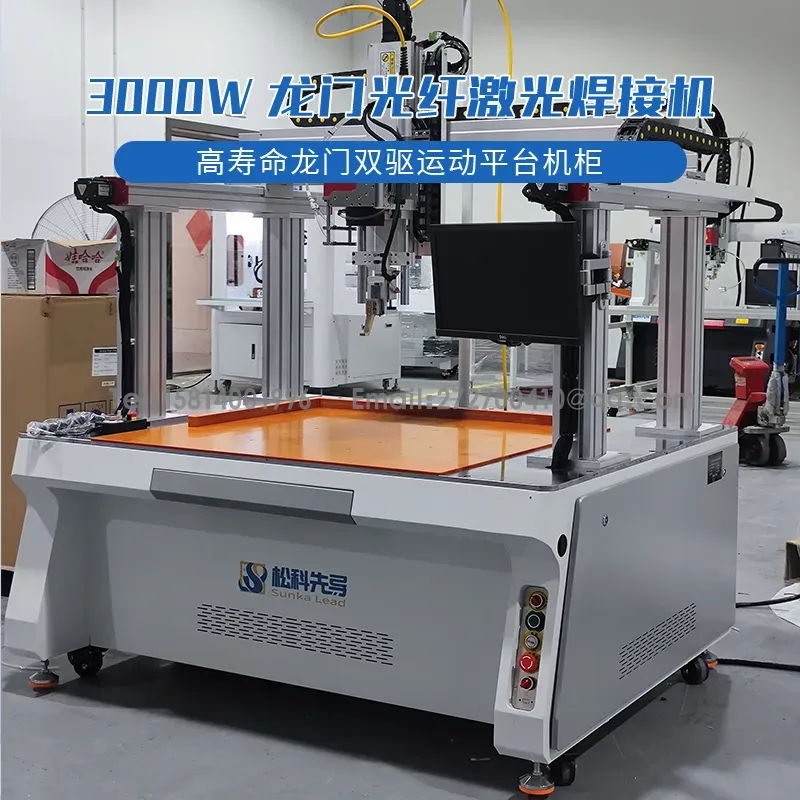
Battery pack laser welding machine technology upgrade: empowering new energy industry efficient and intelligent manufacturing new eraThe 1th one

For a long time, resistance welding, ultrasonic welding and other technologies commonly used in battery pack manufacturing have obvious limitations. Resistance welding generates heat to melt the workpiece through current, but it is easy to cause inconsistent welding strength due to uneven current distribution, and the heat affected zone is large, which may damage the surrounding battery cells. Ultrasonic welding relies on high-frequency vibration to achieve connection, but it has strict requirements on material thickness and surface cleanliness, and is prone to problems such as virtual welding and desoldering, especially in large-size battery module welding. These pain points not only affect the performance of the battery pack, but also increase the maintenance cost in the later stage, restricting the high-quality development of the new energy industry.

The appearance of the battery pack laser welding machine has effectively solved the above problems. The equipment uses a high energy density laser beam as a heat source, which can achieve precise local heating. The welding accuracy can reach ±0.05mm, and the heat affected zone is less than 0.1mm, which is far superior to the traditional welding method. In addition, the laser welding process has no contact and no external force, avoiding mechanical damage to the battery cells; at the same time, the laser beam can be transmitted through the optical fiber, which is easy to integrate with the automated production line to achieve continuous and efficient mass production. For example, after a head power battery company introduced the laser welding machine, the battery pack welding yield increased from 92% to 99.5%, and the production efficiency increased by 40%.

In recent years, the battery pack laser welding machine technology has been iteratively upgraded. First, the use of fiber laser source, stable output power, excellent beam of light quality, suitable for welding of different materials (such as aluminum, copper, nickel); second is the integrated visual positioning system, through high definition camera real-time capture welding position, automatic correction deviation, to ensure welding accuracy; third is to add real-time quality monitoring module, using spectral analysis, temperature sensing and other technologies, online detection of welding defects (such as pores, cracks), timely feedback adjustment process parameters. A new generation of battery pack laser welding machine launched by a laser equipment manufacturer also has adaptive welding function, which can automatically optimize welding power and speed according to cell thickness and material characteristics, and further improve welding quality.

In addition to the field of power batteries, battery pack laser welding machines are also widely used in scenarios such as energy storage batteries and consumer electronics batteries. In energy storage battery module welding, due to the larger size of the module and the larger number of cells, higher requirements for welding consistency are required. The high-precision characteristics of the laser welding machine can effectively guarantee the stability of the energy storage system. In the field of consumer electronics, such as battery packs for smartphones and laptops, laser welding machines can realize miniaturized welding to meet the needs of lightweight products. According to market research institutions, the global battery pack laser welding machine market size will grow at a compound growth rate of 22.3% from 2024 to 2029, with new energy and energy storage contributing the largest increase.

The support of national policies has also promoted the development of the battery pack laser welding machine industry. The "New Energy Vehicle Industry Development Plan (2021-2035) " clearly states that it is necessary to improve the manufacturing process level of power batteries and promote advanced welding technology; the "14th Five-Year" Energy Storage Industry Development Plan also emphasizes that it is necessary to strengthen the research and development and application of energy storage battery manufacturing equipment. These policies provide a good development environment for the technological innovation of laser welding machines. At the same time, with the continuous expansion of the new energy industry, the demand for laser welding equipment from battery enterprises will further increase, driving the industry's technological iteration and market scale expansion.

In the future, battery pack laser welding machines will develop in the direction of higher precision, more intelligence, and greener environmental protection. On the one hand, with the rise of new battery technologies such as solid-state batteries, laser welding machines need to adapt to the welding needs of new materials and structures; on the other hand, intelligent integration will become a trend. By combining with industrial Internet and artificial intelligence technology, the whole process of welding process digital management will be realized, and intelligent factories will be built. It is foreseeable that battery pack laser welding machines will continue to play a key role in the new energy industry, helping the industry to achieve efficient intelligent manufacturing and high-quality development.

classification:


Any back within 30 days


Copyright © 2025-2026 China Manufacturing Source Manufacturer Partner All Rights Reserved

Online message

If you have any suggestions or questions for us, please get in touch.

We use cookie to improve your online experience. By continuing to browse this website, you agree to our use of cookie.

Cookies

Please read our Terms and Conditions and this Policy before accessing or using our Services. If you cannot agree with this Policy or the Terms and Conditions, please do not access or use our Services. If you are located in a jurisdiction outside the European Economic Area, by using our Services, you accept the Terms and Conditions and accept our privacy practices described in this Policy.
We may modify this Policy at any time, without prior notice, and changes may apply to any Personal Information we already hold about you, as well as any new Personal Information collected after the Policy is modified. If we make changes, we will notify you by revising the date at the top of this Policy. We will provide you with advanced notice if we make any material changes to how we collect, use or disclose your Personal Information that impact your rights under this Policy. If you are located in a jurisdiction other than the European Economic Area, the United Kingdom or Switzerland (collectively “European Countries”), your continued access or use of our Services after receiving the notice of changes, constitutes your acknowledgement that you accept the updated Policy. In addition, we may provide you with real time disclosures or additional information about the Personal Information handling practices of specific parts of our Services. Such notices may supplement this Policy or provide you with additional choices about how we process your Personal Information.


Cookies

Cookies are small text files stored on your device when you access most Websites on the internet or open certain emails. Among other things, Cookies allow a Website to recognize your device and remember if you've been to the Website before. Examples of information collected by Cookies include your browser type and the address of the Website from which you arrived at our Website as well as IP address and clickstream behavior (that is the pages you view and the links you click).We use the term cookie to refer to Cookies and technologies that perform a similar function to Cookies (e.g., tags, pixels, web beacons, etc.). Cookies can be read by the originating Website on each subsequent visit and by any other Website that recognizes the cookie. The Website uses Cookies in order to make the Website easier to use, to support a better user experience, including the provision of information and functionality to you, as well as to provide us with information about how the Website is used so that we can make sure it is as up to date, relevant, and error free as we can. Cookies on the Website We use Cookies to personalize your experience when you visit the Site, uniquely identify your computer for security purposes, and enable us and our third-party service providers to serve ads on our behalf across the internet.

We classify Cookies in the following categories:
 ●  Strictly Necessary Cookies
 ●  Performance Cookies
 ●  Functional Cookies
 ●  Targeting Cookies


Cookie List
A cookie is a small piece of data (text file) that a website – when visited by a user – asks your browser to store on your device in order to remember information about you, such as your language preference or login information. Those cookies are set by us and called first-party cookies. We also use third-party cookies – which are cookies from a domain different than the domain of the website you are visiting – for our advertising and marketing efforts. More specifically, we use cookies and other tracking technologies for the following purposes:

Strictly Necessary Cookies
These cookies are necessary for the website to function and cannot be switched off in our systems. They are usually only set in response to actions made by you which amount to a request for services, such as setting your privacy preferences, logging in or filling in forms. You can set your browser to block or alert you about these cookies, but some parts of the site will not then work. These cookies do not store any personally identifiable information.

Functional Cookies
These cookies enable the website to provide enhanced functionality and personalisation. They may be set by us or by third party providers whose services we have added to our pages. If you do not allow these cookies then some or all of these services may not function properly.

Performance Cookies
These cookies allow us to count visits and traffic sources so we can measure and improve the performance of our site. They help us to know which pages are the most and least popular and see how visitors move around the site. All information these cookies collect is aggregated and therefore anonymous. If you do not allow these cookies we will not know when you have visited our site, and will not be able to monitor its performance.

Targeting Cookies
These cookies may be set through our site by our advertising partners. They may be used by those companies to build a profile of your interests and show you relevant adverts on other sites. They do not store directly personal information, but are based on uniquely identifying your browser and internet device. If you do not allow these cookies, you will experience less targeted advertising.

How To Turn Off Cookies
You can choose to restrict or block Cookies through your browser settings at any time. Please note that certain Cookies may be set as soon as you visit the Website, but you can remove them using your browser settings. However, please be aware that restricting or blocking Cookies set on the Website may impact the functionality or performance of the Website or prevent you from using certain services provided through the Website. It will also affect our ability to update the Website to cater for user preferences and improve performance. Cookies within Mobile Applications

We only use Strictly Necessary Cookies on our mobile applications. These Cookies are critical to the functionality of our applications, so if you block or delete these Cookies you may not be able to use the application. These Cookies are not shared with any other application on your mobile device. We never use the Cookies from the mobile application to store personal information about you.

If you have questions or concerns regarding any information in this Privacy Policy, please contact us by email at . You can also contact us via our customer service at our Site.


WhatsApp avatar

Click to Chat.

Im online now.

Hey, my name is Tim. The CPO of JXD, how can I assist you today?

WhatsApp Us

WhatsApp us